Why Do We Clink Glasses?
The strange history of why we bash perfectly good glasses together before drinking.
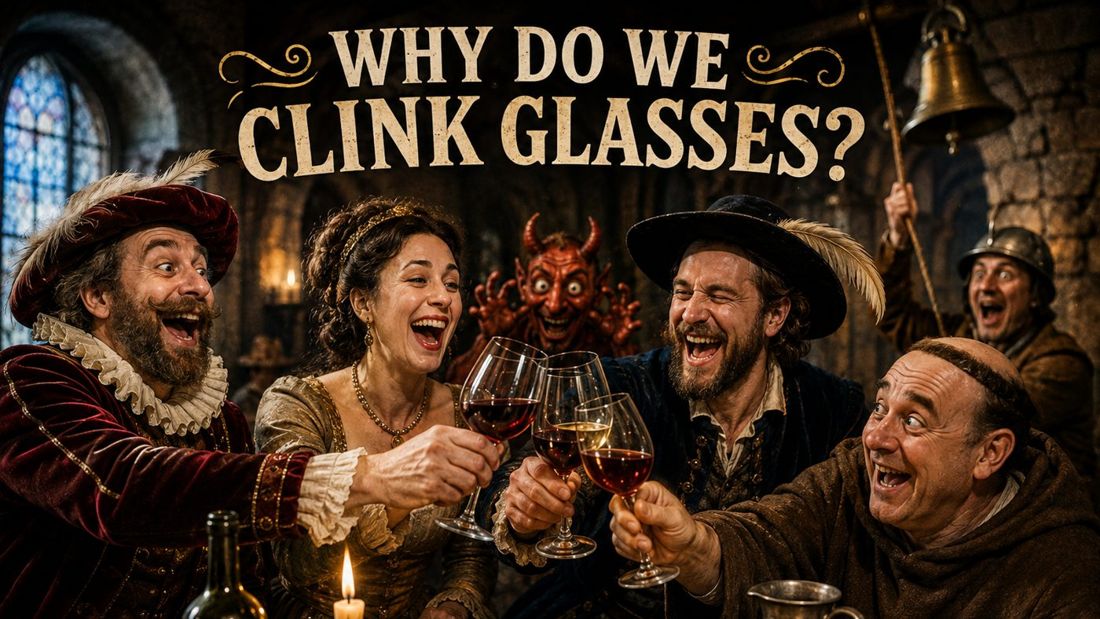
To check nobody had poisoned you The famous story says medieval drinkers smashed their cups together hard enough for a little of each drink to splash into the other person's cup. The message was essentially: “If you've poisoned mine, congratulations, you're having some too.” Wonderful story. Unfortunately, historians aren't particularly convinced it's true. To frighten away evil spirits One theory says the noise of clinking vessels was supposed to scare off troublesome spirits. Apparently demons could cope with war, plague and medieval sanitation, but two goblets going ting sent them fleeing into the night. Because drinking wasn't using enough senses Wine already gives you sight, smell, taste and touch. Clinking glasses adds sound. This explanation is surprisingly popular. Essentially somebody looked at drinking and thought, “Excellent, but what can we do for the ears?” To prove you trusted the other person Raising and bringing your drinking vessel towards somebody else could be a gesture of friendship and goodwill. Nothing says “I come in peace” quite like deliberately moving your pint towards theirs rather than throwing it at them. To get the gods involved Ancient cultures poured libations and made drinking rituals part of religious ceremonies. Raising a vessel could honour gods, the dead or whatever supernatural department was handling that evening's drinking arrangements. Because drinking alone looks suspicious Humans love turning basic activities into ceremonies. Birthdays get candles. Weddings get cake. Ships get champagne smashed against them. Drinking gets everyone holding their glasses in the air waiting for Kevin to stop talking. To make sure everyone starts drinking together The toast creates an official starting gun. Nobody wants to be the person who's already halfway through their glass while everyone else is still listening to Uncle Brian's fourteen-minute wedding toast. Because eye contact apparently matters too In several countries, you're expected to look the other person in the eye while clinking. Germany even has a widely repeated superstition that failing to do so brings seven years of bad sex. There isn't exactly a peer-reviewed body of research supporting this, but remarkably few people seem willing to risk it. Because humans discovered it makes a satisfying noise Possibly the least romantic explanation and therefore one of the most believable. Glasses make a lovely clink. Humans like making things clink. Several thousand years later, we're still doing it.
I'd end the article with something like:
So Why Do We Actually Clink Glasses?
The disappointing answer is that there probably isn't one single origin story. Toasting and drinking rituals developed across different cultures over centuries, and the modern clink appears to be part celebration, part ritual and part social signalling.
The poison story is wonderfully dramatic. The evil-spirit theory is even better. Neither should be presented as established historical fact.
What we do know is that humans somehow took the extremely straightforward activity of putting liquid into their mouths and turned it into a ceremony involving speeches, eye contact, raised arms, synchronized drinking and expensive glassware being deliberately knocked together.
And frankly, drinking is better for it.
Cheers. Just don't hit the glass too hard.
Enough reading. Fancy a drink?
Bargain bottles that go rather well with this story.

Cocktails Ready to Roll